
The Setup
We brought home a 10-week-old golden retriever puppy, Willow, on a Saturday. Sunday night she whined in the crate for four hours. I was about to cave and let her sleep on the bed. Instead, I called a trainer friend, reset my approach, and had her napping voluntarily in the crate by the following Sunday.
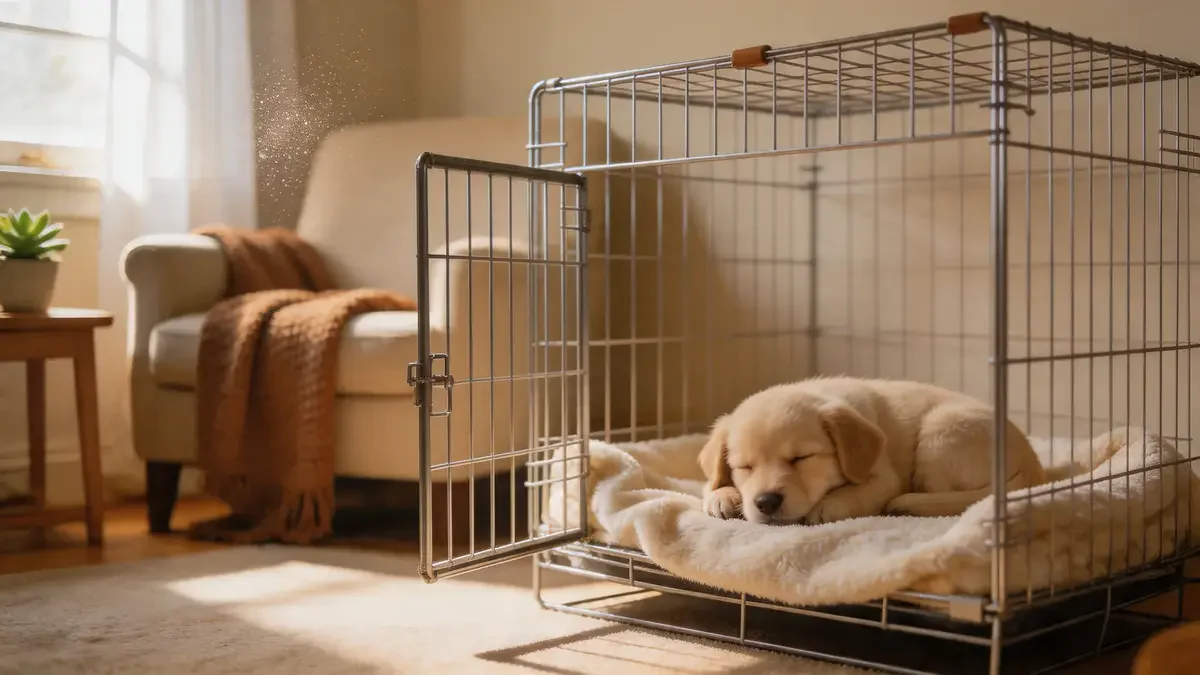
The crate we used was the MidWest Homes for Pets iCrate, a single-door folding wire crate available on Amazon. It comes with a divider panel that lets you start with a smaller interior and expand it as the puppy grows, which matters more than most new owners realize.
The crate we used throughout this process
The MidWest iCrate comes with a divider panel, a removable floor tray, and folds flat for storage. Available in every size on Amazon with Prime delivery. Buy the adult size and use the divider during puppyhood so you're not buying twice.
aBuy on Amazon→Why Crate Size Matters More Than Most Guides Admit
The divider panel that comes with the MidWest iCrate is not a gimmick. A crate that's too large gives a puppy room to sleep on one side and use the other as a bathroom. That's the single fastest way to undermine house training. The divider lets you section off the crate so the available space is just large enough for the puppy to stand, turn around, and lie down. As they grow, you move the panel back.
This one detail explains why some owners struggle with crate training and others don't. The crate and the process have to work together.
Day 1: Make the Crate Attractive, Don't Close the Door
The crate sat open in the living room. I fed Willow her meals at the crate door, then gradually deeper inside the crate. No closed door all day. She went in and out freely and got a treat every time she stepped in voluntarily.
The goal of day one: the crate is a good place, not a cage.
Day 2: Short Closed-Door Moments While I'm Visible
Fed her inside the crate with the door closed for 30 seconds while I sat on the floor in front of it. Opened the door before she started whining. Repeated five or six times throughout the day. The key principle: open the door before she asks, not after. If you open it after whining, you've taught her that whining works.
Day 3: Short Closed-Door Moments While I'm in the Room
Same approach but I moved around the room rather than sitting directly in front of the crate. One-minute intervals, then two, then three. Always opened the door before she complained.
The goal of crate training isn't to endure crying. It's to build a positive association so fast that crying never starts.
Day 4: Short Closed-Door Moments While I Leave the Room
Put her in the crate with a stuffed KONG, left the room for 30 seconds, came back. Extended to two minutes, then five. The frozen KONG gave her a job to focus on, which bought enough time to make the duration extension feel gradual rather than abrupt.
Day 5: Naps in the Crate
After a good play session, when she was naturally tired, I put her in the crate with the KONG and let her settle. She napped for 45 minutes with the door closed. I stayed in the house.
Day 6: Overnight in the Crate
The biggest step. The MidWest iCrate went in the bedroom next to the bed, not in another room. Final potty break at 10:30pm, into the crate at 11pm with a small treat hidden in the blanket. She whined for three minutes, settled, and slept until 4:30am. Out to potty. Back in. Slept until 6:30am.
The crate in the bedroom matters for the first week or two. She can smell you and hear you. It removes the separation component from the equation while the positive association is still building.
Day 7: A Morning Alone in the Crate
I left for a 45-minute errand. Came back to no accidents, no destruction, and a puppy who was asleep. That was the moment I knew it had worked.
What Made It Work
- The MidWest iCrate with the divider set correctly for her size. Too much space undermines house training.
- Crate in the bedroom the first two weeks. Never in another room during early training.
- Fed every meal inside the crate for the first 14 days.
- Built duration in actual minutes: 30 seconds, 2 minutes, 5 minutes, 15 minutes. Not hours.
- Never opened the door while she was whining. Always before or during a moment of quiet.
What Didn't Work
- Leaving her to cry it out the first night. Four hours of panic with no useful learning.
- Moving the crate to another room too early.
- Opening the door once when she whined. Set us back two full days.
The crate we'd buy again without hesitating
The MidWest Homes for Pets iCrate. The divider is the feature that matters most. Buy the adult size of your breed and use the divider during puppyhood. Available on Amazon in every size with Prime delivery.
aBuy on Amazon→